News
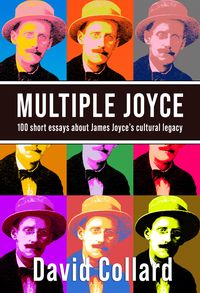
☞ Nuala O'Connor on Multiple Joyce in Books Ireland
“A rare, delicious treat for readers, and a book that would have tickled Joyce, with its vibrant potpourri of playfulness, punning, and pathos…. I defy Joycean purists not to be totally beguiled by this absorbing, upfront, funny, erudite, and charming book.”
—Nuala O’Connor, in Books Ireland Magazine
☞ “What Causes Pip in Poultry?”
3:AM Magazine published an excerpt from David Collard’s Multiple Joyce.

☞ Hunter Liguore on Kinderkrankenhaus in Strange Horizons
☞ An excerpt from Multiple Joyce
The Irish Examiner published an excerpt from David Collard’s Multiple Joyce.
☞ Anne Cunningham on Multiple Joyce in Meath Chronicle
“Collard is a wry and gifted essayist as well as an expert on Joyce. But he simply refuses to take himself—or Joyce, or indeed anything—too seriously…. [Multiple Joyce is] frequently bloody hilarious. It’s also erudite and considered, written by a cultured soul with a highly polished proclivity for satire…. I cannot recommend this delightful, unusual work highly enough. Bravissimo.”
—Anne Cunningham, Meath Chronicle
☞ Jackie Law on Multiple Joyce in Never Imitate
“Written with impressive intellectual rigour but also a strong undercurrent of wit…. a most enjoyable way to learn more about Joyce.”
—Jackie Law, in Never Imitate
☞ “The Summer We Ate Off the China,” the title story of The Summer We Ate Off the China
Vol. 1 Brooklyn published the title story of The Summer We Ate Off the China in its Sunday Stories series.
☞ Carl Landauer on The Blank Page in Poetry Flash
“With The Blank Page, Iván Argüelles brings us another volume of poems, written in daily increments, that marshal a vast expanse of literature and myth with wonderfully imaginative juxtapositions. The poems venture into the most significant questions of life and death, as well as the effort, often impeded, to convey meaning….
“Argüelles has developed the framework for his books as daily poems, with a date penned at the end of each, so we experience the rhythm and flow of his imagination. Essentially, we have a journal, which is why a volume he published the year before was titled Diario di un Ottogenario…. When Argüelles worked at the large New York Public Library building at Fifth Avenue and 42nd Street, he wrote poems during his lunch hour, aligning them with Frank O’Hara’s practice of writing his Lunch Poems during lunchtime at the Museum of Modern Art. Even if Argüelles no longer has a lunch hour, we still have the record of a daily appointment with his craft….
“Argüelles’s playfulness is related to his close reading of Surrealist poets, particularly his fondness for Philip Lamantia, Federico García Lorca, and César Vallejo. His is not the cadavre exquis non-sequitur poetry of some of the Surrealist tradition. But rather the soft, playful blending of realities…. Overall, Argüelles shares the core Surrealist goal of eliminating the boundary between the conscious and unconscious, and evidences a desire to tap an oneiric realm….
“In this book of poems, Argüelles tells us that ‘poetry is narcolepsy / the wish to return where there is no space.’ Of course, to us, narcolepsy is unwanted sleep, a ‘lepsy’ that seizes us, rather than driven by a wish. But it is an oneiric realm that Argüelles moves in and out of in the poetry of The Blank Page.”
—Carl Landauer, in Poetry Flash
☞ Eric Williams on Condemned to Cymru in Heavy Feather Review
“M.J. Nicholls’ new novel Condemned to Cymru is Rabelaisian in every sense of the word: it’s gross, it’s droll, there’s sex and violence and jokes. It even affects the Rabelaisian flourish of an artificial structure—the story is mostly presented as one pathetic misanthrope’s alphabetized travelogue (of sorts) of Wales, written for a sinister Icelandic thinktank bent on world domination. And much like Rabelais, beneath all the playful language and grotesqueries is a story concerned with people, society, suffering, and justice (or the lack thereof)… [T]his book is a tremendous amount of fun, and even the bleakest parts have a core of playfulness to them. M.J. Nicholls has written a clever, surprising story, equal parts funny and despairing, sharp enough to keep you reading a literal alphabetical list of Welsh towns, parsing a tangled story overheard in a pub for deeper meanings, or trying to find the metacommentary behind a giant rampaging buttocks smashing the local sheep to smithereens.”
—Eric Williams, in Heavy Feather Review
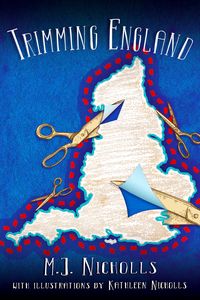
☞ Alistair Braidwood on Trimming England in The Bottle Imp
“There’s no-one else writing today with his dry humour, wry eye, withering wit, and mastery of styles.”
—Alistair Braidwood, in The Bottle Imp