News
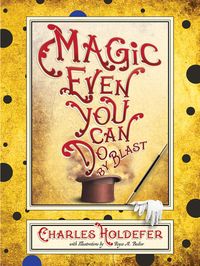
☞ Tom Frame on Magic Even You Can Do: By Blast in Genii Magazine
“Behind a radiator in the La Serrurerie café in Poitiers, France, Mr. Holdefer found an important, long-lost manuscript written by the legendary, imaginary magician ‘Blast.’ Mr. Holdefer faithfully restored the greasy, tattered manuscript and has now published it as Magic Even You Can Do, a beginner’s magic book.
“This wee tome is very attractive. Royce M. Becker’s design and colorful illustrations are beautiful.
“Mr. Holdefer is an abundantly gifted, witty writer. His creation, his delightful doppelganger Blast, is a funny, goofy, erudite, Baron Munchausen of magic….
“Magic Even You Can Do is a wonderful, wacky, whimsical romp! You’ll breeze through it in less than an hour, grinning toothily from ear to ear with the turn of each page. Blast is a blast! I hope we see more of him in the future.
“Since no real magic methods are revealed, you can heartily recommend this book to your lay friends. They will be thrilled, and feel empowered that their Rube Goldbergian explanations of magic have been validated. Such a satisfying swindle!
“Highly Recommended.”
—Tom Frame in Genii Magazine
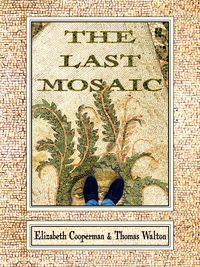
☞ Elizabeth Cooperman and Thomas Walton on Glossophonics
Elizabeth Cooperman and Thomas Walton talk about The Last Mosaic on Glossophonics.
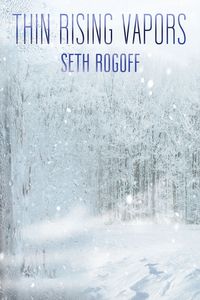
☞ Thomas Urquhart on Thin Rising Vapors in The Portland Press Herald
“The mere act of reading the book gives pleasure, even when the story line is perplexing….
“While a snowstorm rages outside, what was meant to be an overnight stay in Prager’s unlit, unheated house is extended, day by day. Where in Rogoff’s other book, a blizzard contributed to its overall claustrophobia, here it poses an existentialist question: the elements that are snowing Ezra in, are they external or internal?… Back in Casco during the blizzard Ezra Stern developed a daily routine, which I recommend. Fetch the logs from the woodpile, light up the Franklin stove, pull up the rocking chair. Now savor the beguiling uncertainty of Thin Rising Vapors.”
—Thomas Urquhart in The Portland Press Herald
☞ Thin Rising Vapors in BooksOnGif
“Rogoff writes beautifully. I saw him read an excerpt of this book at the wonderful KGB Bar in the East Village a few months back, and it was a real treat to hear his sentences out loud. But while this book is well written, it initially frustrated me because I thought it raised a lot of questions that went unanswered. For example, Ezra becomes so overwhelmed by his grief and by the intensity of what he uncovers that he abandons his investigation….
“I thought about this book for a week, and couldn’t even start a new one while my mind chewed on it. What was Rogoff after here?… Maybe Rogoff is instead trying to warn us about the peril of choosing to be a political, intellectual or social hermit in this current climate. While it is tempting to want to just get away from Twitter trolls and all the horrible headlines about mass shootings and racism and all the other evils of the world and go live like Thoreau in the forest, … maybe that’s a path that leads to our death. I don’t know if this is right, but the more I think about it, the less frustrated I feel. Regardless, Rogoff has given me a lot to think about….”
☞ Paul Nelson interviews Elizabeth Cooperman and Thomas Walton
In Dispatches from the Poetry Wars, Paul Nelson interviews Elizabeth Cooperman and Thomas Walton about The Last Mosaic.
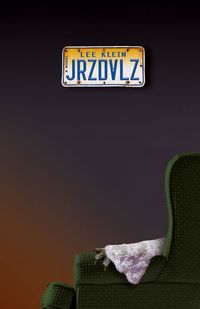
☞ Jesi Buell on JRZDVLZ in Heavy Feather Review
“The most interesting element of this novel is this central theme of how fact is buttressed by fiction (and vice versa). It forces the reader to question how (hi/)stories are made and how our words make the intangible (the imagined and the opinion and the holy) come alive. As the Devil endures through these legends, he is also trying to understand his own story, one that is not fully in his control. Several times, the Devil questions if he really exists or if he is just another horror story created by a restless, fearful crowd…. JRZDVLZ will appeal to fans of Süskind’s Perfume and Shelley’s Frankenstein.”
—Jesi Buell in Heavy Feather Review
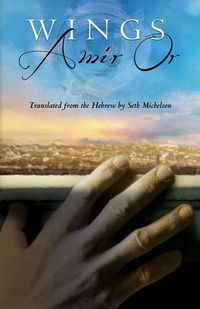
☞ Kenneth J. Pruitt on Wings in Rain Taxi
“The self as multiplicity, the failure of religion, the collision of past, present, and future: philosophical ideas are stitched together here to bolster an overtly political poem.
“This is how poetry is useful. This is how poetry does something. With this newly translated edition of Wings, Amir Or is finally able to open a dialogue with readers in the United States. May we respond to the invitation.”
—Kenneth J. Pruitt, in Rain Taxi
☞ On Cover to Cover with Jack Foley
Elizabeth Cooperman and Thomas Walton discuss The Last Mosaic with Jack Foley on KPFA’s Cover to Cover, in two parts.
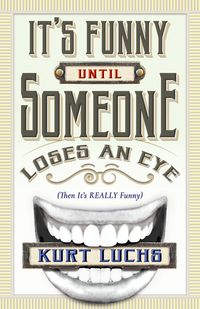
☞ Scott Dikkers interviews Kurt Luchs on How To Write Funny
Scott Dikkers talks with Kurt Luchs about his comedy career on the occasion of It’s Funny Until Someone Loses an Eye (Then It’s Really Funny).
☞ Anton Romanenko on Thin Rising Vapors in Body
“[An] important question that Thin Rising Vapors poses is that of the relationship between the author and the interpreter. In Rogoff’s novel it seems at first that Ezra is in charge of his narrative. He not only seems to control his actions, but he also decides what pieces of Abel’s papers are to be shown to the reader. But as the story proceeds, Abel’s voice grows more and more independent. His papers begin to occupy more and more pages in the book. Finally, it seems that Abel almost starts competing with Ezra for the role of the leading narrator. Soon his writings seem to be commenting on Ezra’s commentary. At the same time Ezra begins to think about his life in light of what he reads. He also begins to feel that he is losing control…. Rogoff’s strategy in portraying Abel’s solitary drama is to show it as the conflict between dimensions that are fundamentally at odds with each other: theory and practice, past and present, biology and soul.”
—Anton Romanenko in Body